

In the humidifier manufacturing industry, the ultrasonic Ceramic atomizer plate is the core component that determines the performance, energy efficiency and life of the equipment. According to statistics, more than 70% of humidifier failures are caused by inferior Atomizer Plates, while high-quality Atomizer Plates can improve atomization efficiency by more than 30% and reduce energy consumption by 50%.
As a humidifier manufacturer, how to choose an ultrasonic Ceramic atomizer plate with high cost performance, long life and stable atomization effect from many suppliers? This article will provide a complete purchasing decision guide from the dimensions of technical parameters, material process, supplier evaluation, industry certification, etc.
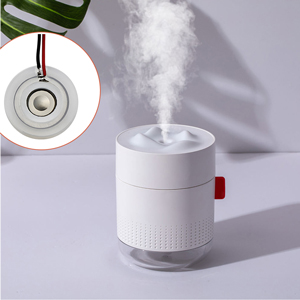
1. The core role of ultrasonic Ceramic atomizer plate
1.1 Humidifier atomization principle
The Humidifier Atomizer Plate is the heart of the entire humidifier. What is the atomization effect? Is the mist produced stable and small in particles? For the humidifier itself, the Atomizer Plate plays a significant role.
Ultrasonic Atomizer Plate breaks water molecules into 1-5μm fine water mist through high-frequency vibration (1.7MHz~2.4MHz). Compared with traditional heating humidification, it has the advantages of energy saving, quietness and fast humidification.
Features of high-quality Atomizer Plate:
Uniform atomization particles (1-5μm, avoid "wetting the desktop")
Low energy consumption (usually 3-5W, 80% energy saving than heating)
Long life (more than 5000 hours, inferior products may only 1000 hours)
1.2 Common problems of inferior Atomizer Plate
Low atomization efficiency (large particles, poor humidification effect)
Easy to scale and clog (special attention should be paid to areas with poor water quality)
Short life (fracture of vibration plate, oxidation of electrode)
High noise (unstable resonant frequency)
So how to find low-noise, low-power, stable and reliable Atomizer Plate with long life is a very big issue for humidifier manufacturers
II. Key parameters: How to evaluate the performance of Atomizer Plate?
2.2 Material selection: piezoelectric ceramics vs. ordinary metal sheets
Ordinary metal sheets: low cost, but easy to corrode and short life.
Piezoelectric ceramics (PZT-4/PZT-8):
PZT-4: high stability, suitable for home humidifiers.
PZT-8: industrial grade, resistant to high temperature and high pressure, suitable for medical/industrial humidification.
III. Supplier screening: 5 key evaluation criteria
3.1 Is it RoHS certified?
RoHS: ensure that there are no harmful substances such as lead and cadmium.
3.2 Is a PSD (particle distribution) test report provided?
Suppliers are required to provide laser particle size analyzer test data to ensure that the atomized particles are within the range of 1-5μm.
3.3 Is customization supported?
Diameter (common 10mm/16mm/20mm)
Frequency (1.7MHz/2.4MHz)
Waterproof packaging (epoxy resin/stainless steel coating)
3.4 Is life test data provided?
High-quality suppliers will provide accelerated aging test reports (such as performance changes after 500 hours of continuous atomization).
3.5 After-sales policy
Warranty period (1 year or 2 years?)
Does it support free sample testing?
IV. Procurement decision-making process
Clear requirements (home/commercial? Atomization volume? Budget?)
Request samples (test atomization volume, noise, power consumption)
Verification and certification (RoHS/ISO/other product quality reports)
Small batch trial production (observe long-term stability)
Sign a long-term agreement (strive for the best price)
Conclusion: Choose high-quality Humidifier Atomizer Plate = Improve product competitiveness
Poor-quality Atomizer Plate may lead to customer complaints, high repair rate, and damage to brand reputation. Although the unit price of high-quality Atomizer Plate is slightly higher, it can significantly improve user experience and reduce after-sales costs.